Green AI Institute
Building a world where artificial intelligence is not just intelligent, but also sustainable.
What Is Green AI?
Green AI is an approach to artificial intelligence research and deployment that treats computational efficiency as a primary evaluation criterion alongside accuracy. The term was coined by Schwartz et al. in a 2020 paper published in Communications of the ACM, distinguishing it from "Red AI" — the dominant paradigm that improves results by scaling compute regardless of environmental cost.
Green AI encompasses two complementary dimensions:
- Green-in-AI: Making AI systems themselves more sustainable through model compression, small language models (SLMs), efficient hardware (TPUs, spiking neural networks), edge computing, pruning, and quantization.
- Green-by-AI: Using AI to solve environmental problems — optimizing smart grids, predicting renewable energy output, monitoring deforestation via satellite imagery, and improving industrial energy efficiency.
As of 2025, global data centers consume approximately 1.5% of worldwide electricity (415 TWh according to the IEA), with AI-focused facilities growing at 17% year-over-year. The IEA projects data center consumption could reach 1,050 TWh by 2026 — equivalent to the electricity use of Japan.

Who We Are
The GreenAI Institute is a collective of visionary researchers, academics, and professionals dedicated to advancing the integration of artificial intelligence and environmental sustainability.
Our team is comprised of experts from some of the world's leading educational institutions, including Harvard University, Stanford University, and other renowned centers of academic excellence.
Join our mission →
Why Green AI?
Sustainable computing is becoming increasingly crucial in our modern world due to the ever-growing demand for computational power and the associated environmental impacts. Data centers, the backbone of today's digital economy, consume vast amounts of energy—contributing significantly to global carbon emissions.
According to the IEA (2025), data centers worldwide consumed approximately 1.5% of global electricity in 2024 (415 TWh), a figure projected to more than double by 2030. By adopting sustainable computing practices, we can mitigate the environmental footprint of these facilities and contribute to reducing greenhouse gas emissions.
The Global AI Environmental Impact white paper proposes the Green AI Index—a set of criteria to evaluate the environmental effects of AI technologies, assessing energy consumption, carbon footprint, resource utilization, and sustainability practices.
Learn More →The Green AI Summit
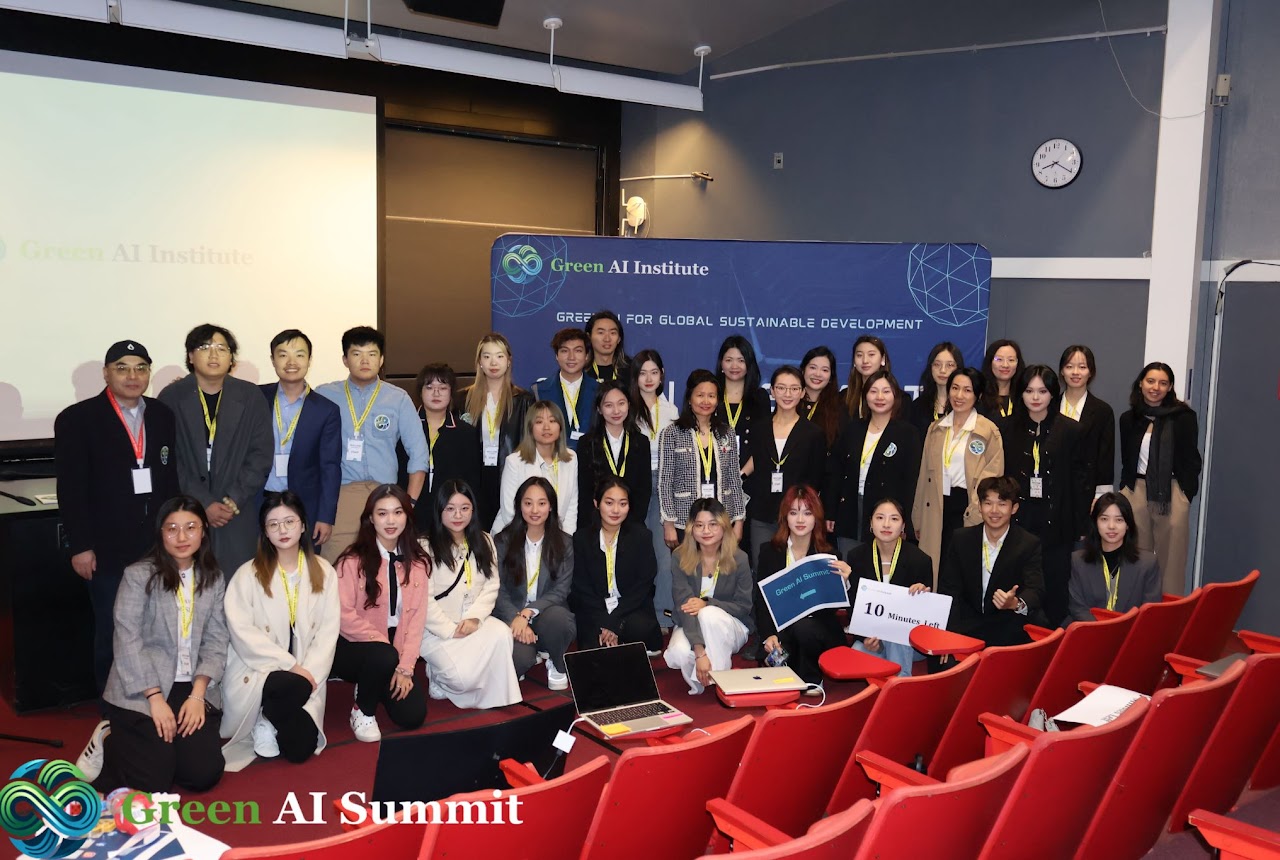
The summit focuses on climate change, clean energy technologies, AI's environmental impact, and green investment. Through roundtable discussions, expert presentations, and collaborative sessions, we analyze AI's environmental impacts and investigate how green financial innovation can promote sustainable development.
Learn More Details →
Volunteering Positions are OPEN!
We sincerely invite you to join this significant annual event, working alongside global thought leaders to contribute ideas for the future of AI and sustainability. The Green AI Institute aims to unite young people, politicians, business leaders, and academics to jointly address climate change and create a sustainable global community.
Apply Now
Get in Touch — Collaborate With Us
Whether you want to join as a member, partner with us, volunteer at the summit, or simply stay informed—we’d love to hear from you. Take the next step and connect with the Green AI community.
Frequently Asked Questions
What is Green AI?
Green AI is an approach to AI development that prioritizes computational efficiency and environmental sustainability alongside performance. Coined by Schwartz et al. (2020), it contrasts with "Red AI" which pursues accuracy gains through ever-increasing compute. Green AI includes both making AI systems more efficient (Green-in-AI) and using AI to solve environmental challenges (Green-by-AI).
How much energy does AI consume?
Global data centers consumed approximately 415 TWh of electricity in 2024, about 1.5% of worldwide demand (IEA, 2025). AI workloads account for a growing share — projected to reach 32% of data center electricity by 2026. Training a single large language model like GPT-4 consumes roughly 50 GWh of electricity (Epoch AI).
What is the Green AI Index?
The Green AI Index is a comprehensive framework developed by the Green AI Institute for assessing the environmental impact of AI systems and data centers. It evaluates energy consumption (PUE), carbon emissions (Scope 1-3, CUE), and water use (WUE) across the full AI lifecycle — from hardware manufacturing through model training, inference, and disposal.
What is the difference between PUE, WUE, and CUE?
PUE (Power Usage Effectiveness) measures energy efficiency: total facility energy divided by IT equipment energy (ideal: 1.0, industry average: 1.58). WUE (Water Usage Effectiveness) measures water consumption per kWh of IT energy (industry average: 1.8 L/kWh). CUE (Carbon Usage Effectiveness) measures CO2 emissions per kWh of IT energy. Together, these three metrics provide a holistic view of data center environmental impact.
How can AI be made more sustainable?
Key strategies include: using energy-efficient hardware (TPUs, specialized accelerators), model compression techniques (pruning, quantization, knowledge distillation), training on renewable-powered data centers, optimizing inference with smaller models (SLMs), improving data center PUE through advanced cooling, and adopting lifecycle assessment frameworks like the Green AI Index.